

Finding charts for MMIRS
Making good finding charts for MMIRS
The MMIRS instrument requires finding charts for long-slit spectroscopy to align the target onto the slit. (Finding charts are useful for direct imaging, and not required for multi-slit masks.) The observers take short direct images of the field and align the target to a fiducial position, then move the longslit into position. Thus, it is critical that either the target or an alignment star be visible in a short exposure on the science detector, and that the finding chart allows the observers to uniquely identify the target.
Many problems with acquiring MMIRS longslit targets can be avoided with attention to the target properties and making good finding charts. Here we show some examples.
A target for MMIRS longslit should either (1) be visible on the detector, which means roughly mag=18 or brighter; or (2) should have an offset star within ~1.5 arcmin provided in your catalog entry with “Add Offset Star,” and the slit PA set to the PA running between star and target. See Offset star coordinates for details. The star will be centered on the slit and the PA will run the slit across the target. MMIRS does not do blind offsets from the star to the target, because that has not worked well in practice. For clarity, please enter just one offset star, the one that corresponds to the PA entered into the target.
The chart should always clearly indicate: the target location, offset star if used, orientation (preferably North up, East to left), and a scale bar.
Generally, if the target isn’t visible on your finding chart, it is unlikely to be visible on the MMIRS detector and you’ll need an offset star and slit PA. There are exceptions like newly discovered bright supernovae versus old survey images, but keep in mind that if the target is not in the chart / is variable, its brightness is not predictable. We often have problems with targets that have outdated estimated magnitudes because they have faded.
Finding charts with visible targets
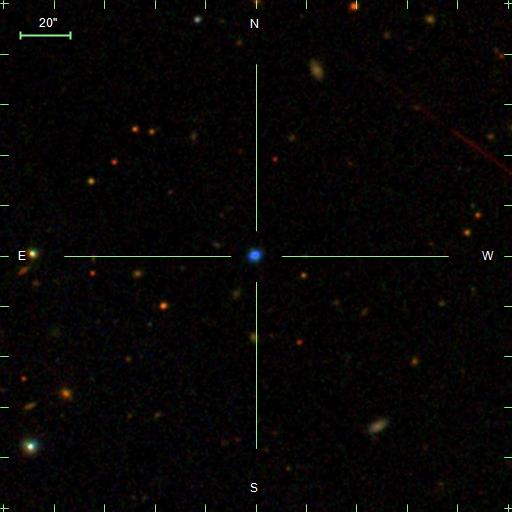
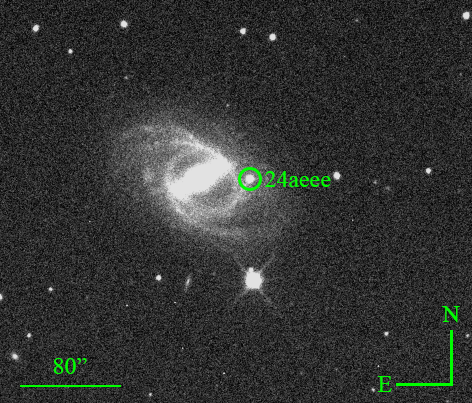
These are finding charts where the PI had imagery that showed the target. The first image is an SDSS imageserver finding chart for a white dwarf. The target is bright and isolated. Here two secondary concerns are: will the target be bright enough in the IR, since it’s rather blue; and if the target has large proper motions, be sure to give its current coordinates in your catalog. As always, a scale bar is useful for the observers comparing the chart to the acquisition image.
The second image is a recent supernova in a relatively nearby galaxy, where the PI had access to post-explosion imaging and made a finding chart from it. The PI was fairly sure that the target would be bright enough to find in MMIRS. If it were not, an offset star is needed. Note that if someone tries to take a spectrum again months later, the SN will likely fade and a new chart/offset star will be needed.
Finding chart with offset star
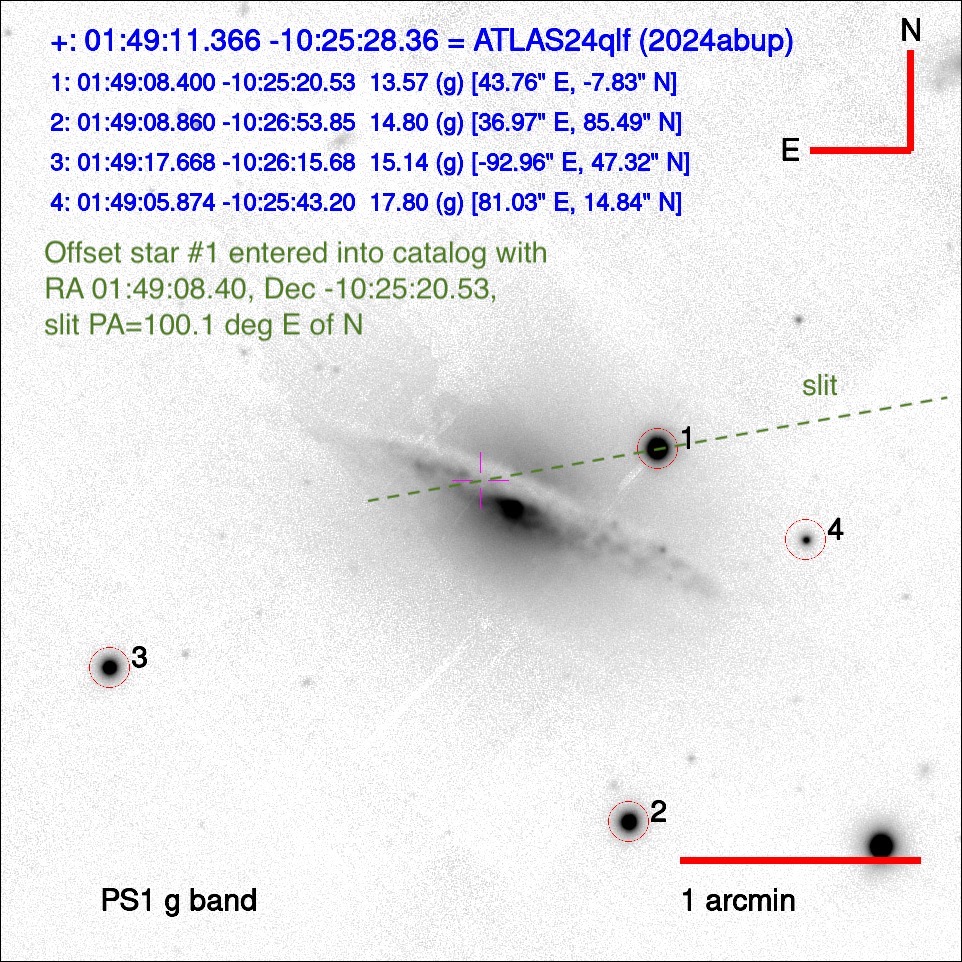
This chart for SN2024abup is not perfect since the target is not visible – it uses PanSTARRS-1 imagery that was taken before the SN went off. But it is good because there is a clearly visible, bright, well-isolated offset star, and a PA from the star to the target. The PI should create the catalog target with the RA, Dec of the SN, and the indicated slit PA. The RA, Dec of the star is then added using the “Add Offset Star” feature in the catalog dialog box. Although there is more than one star on the chart, you should only enter the offset star that corresponds to the correct PA. Also, the scale of the chart in arcmin is clearly marked and is well matched to the MMIRS imaging field of ~ 4 arcmin. (Credit: the chart image came from the Transient Name Server, with further text and slit PA added by MMT staff.)
Finding chart with problems
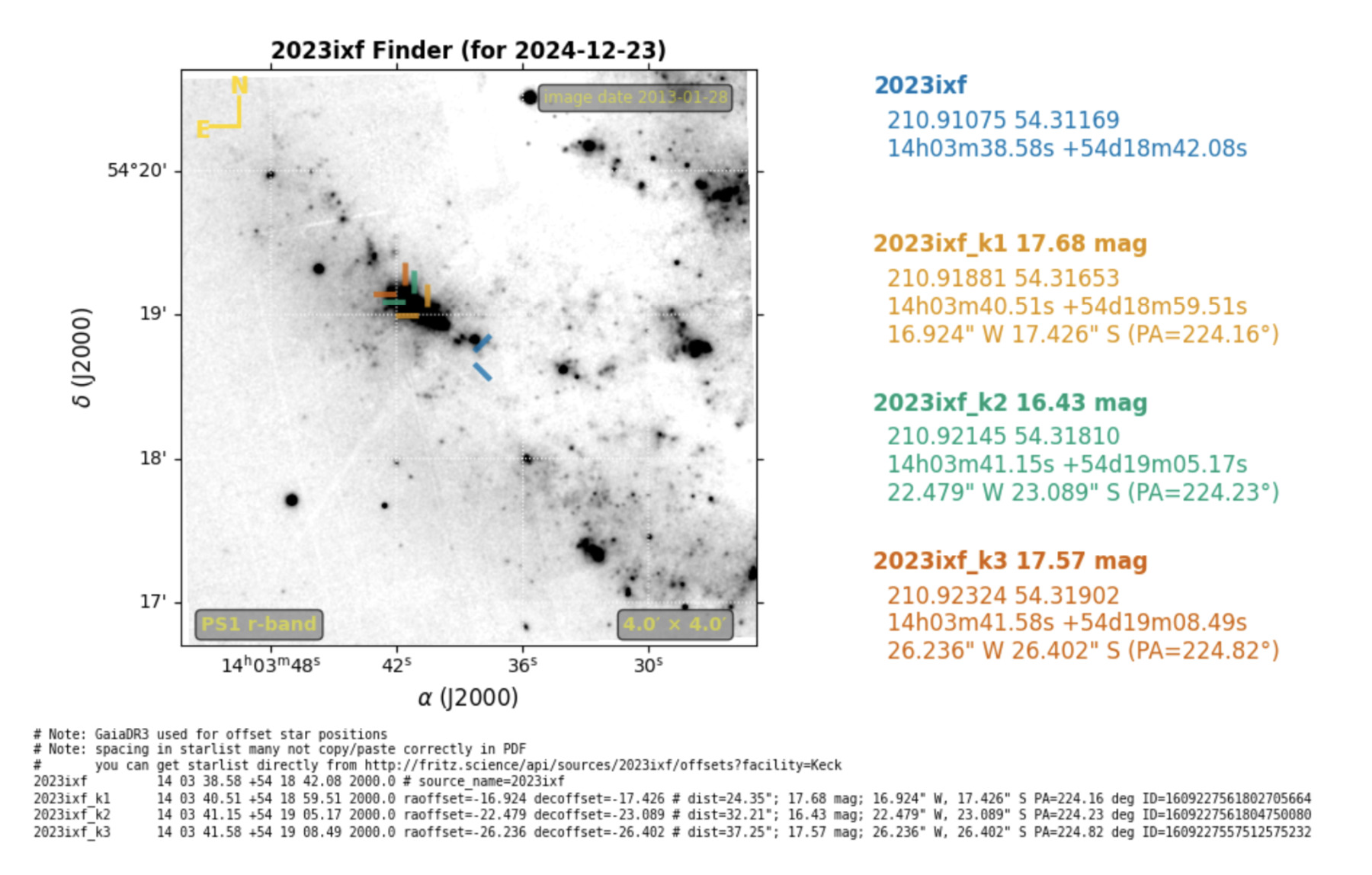
This finding chart will cause serious problems at the telescope, and the target will not be observable. This chart was generated by the ZTF survey automatically (I think) and illustrates some problems with finding charts that have not been carefully vetted by the PI. Problems include: (1) the PS1 imagery is pre-supernova and so the target is not visible in the chart; (2) the SN itself is old (2024 observing request for a 2023 SN) and so is faint, and the observers won’t be able to see it in a direct image. Ordinarily, the PI can compensate for this by entering an offset star and slit PA. However, in this chart, the chart-making script has automatically labeled 3 stars and their coordinates, but the stars (colored horiz/vert tickmarks) are crowded together in an overexposed part of the chart. The observer isn’t going to be able to find the offset star unambiguously by matching a direct image to the chart.
The PI should either (1) find the coordinates and PA of an isolated bright star with mag<=18 and use that as the offset star (perhaps the star an arcmin southeast of of the SN is bright enough); or (2) remake the chart so that the brightest of the nearby stars can be located unambiguously. Either way, a star should be added to the catalog with “Add Offset Star” and the slit PA should be specified. Enter only one star (just its RA/Dec) and put the PA that goes with it in the PA box of the main target.
Offset star coordinates
RA/Dec coordinates for offset stars are assumed to be in equinox=2000 and epoch=2000. Generally, you should not need to enter proper motions for an offset star. What you need to do is ensure the PA from star to target is correct for the current epoch. Very small motions like ~0.1 arcsec will typically not affect the derived PA enough to notice. For MMIRS, you can usually provide the star coordinates with PMs=zero for acquisition. Also, do not enter anything in the “Offset” field of the offset star. The idea is that the telescope will point at the star, the queue observer will take an acquisition image without the slit and find the star, then take an image with the slit, and move the star onto the slit. The slit will have both the offset star and science target in it.
For MMIRS, the queue observer can find the offset star in the acquisition image, so if the proper motions are small-but-nonzero, they can still find the star, as long as you computed the slit PA correctly for the current epoch. (This is unlike Binospec, which doesn’t take acquisition images and sets directly onto the target. So Binospec requires absolute coordinates for the target, but thus also doesn’t need offset stars.)
If you do dare enter proper motions for an offset star, they have to be in the MMT units of sec-of-time and sec-of-arc per century, not mas/yr, and referenced to epoch=2000, so I strongly suggest not trying this. See MMT spectrophotometric star information for more info on the PM units, but really, just use a star with small proper motions.